EDIT SCULPTURE편집조각®
DAEVINCI
ABOUT
The artist directly photographs things that once existed in order to construct scenes that never did.
Real places, objects, people, light, and textures are photographed across different times and spaces, then separated and rearranged into a single image. This process accumulates as an archive.
The artist calls this way of working Edit Sculpture. Edit Sculpture is both an attitude toward photography and a methodology—a language that articulates the thinking and practice through which he understands and works with the photographic medium.
Edit Sculpture always begins with the real. The completed scene may never have existed before the camera, yet every element that constitutes it was photographed in the physical world. Once removed from their original contexts, these photographed elements form new relationships and are sculpted into a different configuration.
Within the works, conditions that shape reality—such as the relationship between nature and humanity, social rules and freedom, and physical order—are sculpted through the artist’s visual language and concepts. What the artist sculpts is not unreality itself, but a potential state of reality constructed from evidence of the real.
The artist inhabits both reality and unreality at once,
observing the world that exists between them.
WORK PROCESS
Daevinci builds his images from fragments of reality.
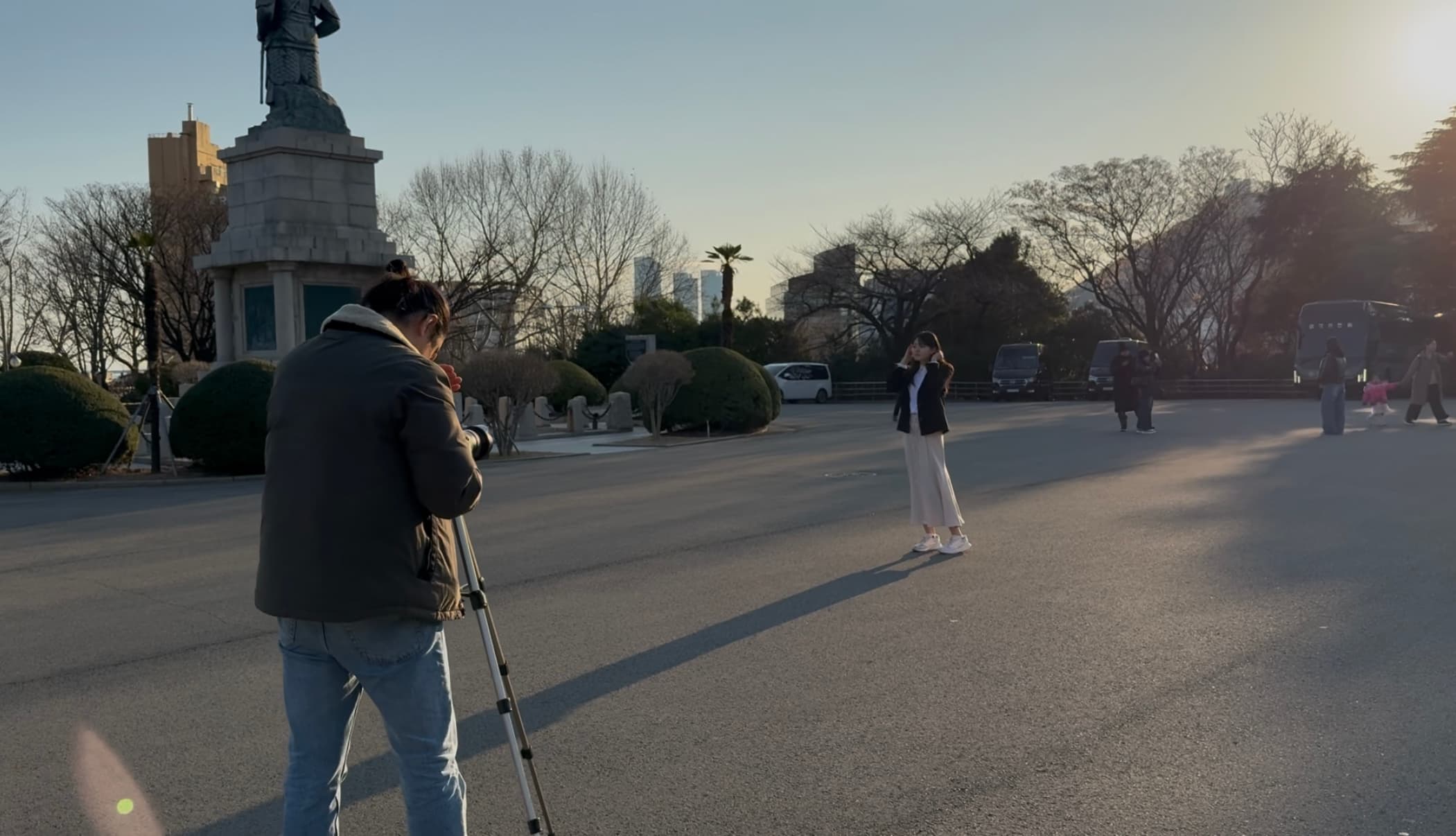
Each work begins with a scene he imagines as plausible within the logic of the real world. Rather than documenting a moment, he constructs one. To materialize this vision, he searches for and photographs each element individually — locations, objects, light, atmosphere — across different times and spaces.
He places strong emphasis on physical realism. Light, perspective, scale, and spatial coherence must align before the image can exist as a believable moment. For this reason, he revisits locations repeatedly, refining conditions until they support the constructed vision. Every fragment is captured intentionally, and no element is incidental.
The process does not rely on computer-generated imagery, stock material, or illustrated components. All visual elements originate from his own photographs. The final image is assembled through structural editing, where independent fragments are reconstructed into a single cohesive reality.
Daevinci oversees every stage of production himself — from concept and field research to photography and post-production — maintaining complete control over the integrity of the work. The strength of the final image is inseparable from the clarity of the idea and the precision of each captured fragment.
Because each work requires extensive research, repeated location visits, and meticulous assembly, the process is time-intensive. The result is not an altered photograph, but a constructed moment — a reality built from reality.